
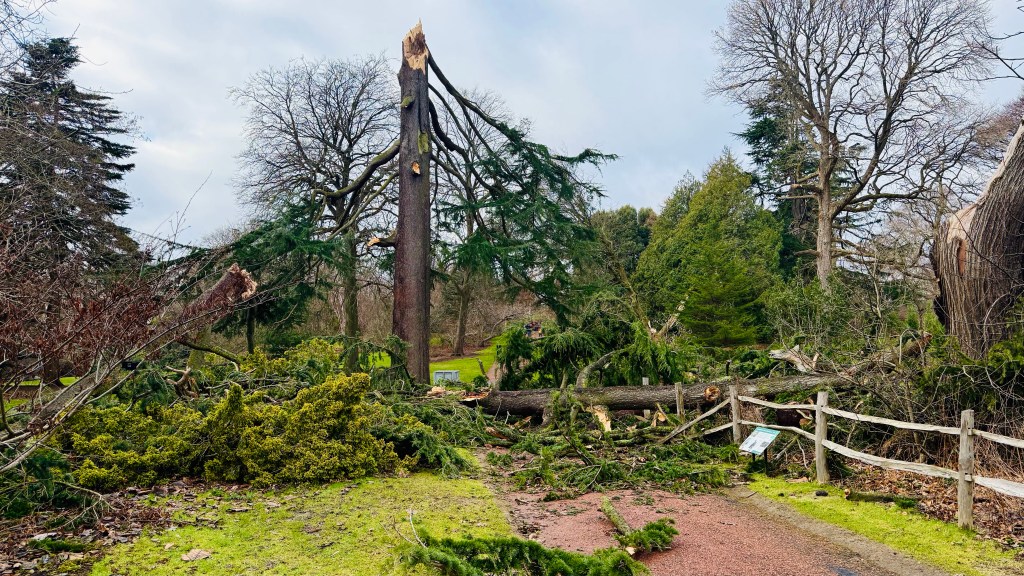
The worst storm to batter Scotland in decades cleaved the Royal Botanic Garden of Edinburgh’s signature 100ft cedar tree in two.
First Published: 9th February 2025
Two weeks after Storm Éowyn’s 100mph winds wreaked havoc in a rare red weather warning, Scotland’s four Royal Botanic Gardens are still planning out its recovery.
This week’s cold snap – a return to typically chilly February conditions after a warmer start to the month – feels like a walk in the park compared to the unforgiving weather of late January.
Nevertheless, a walk in the park is exactly what’s needed to get a sense of scale of the recovery effort now underway to return the Royal Botanic Garden Edinburgh back to its majestic state.
The 70-acre capital’s garden was first established in 1670, but has existed at its current site in Inverleith in 1820.
Today it’s one of four Royal Botanic Gardens found across Scotland.
Due to significant risk to life from Storm Éowyn on Friday 24 January, the horticulture team wasn’t able to return to the garden until Saturday morning.
Suzie Huggins, RBG Edinburgh Communications manager, said, “None of us knew the impact until they started to walk in.
“At the same time, the same thing was happening at our three other gardens, as people went round and from our perspective we started to get the news filtering in.
“The first big news was the cedar coming down.”
Suzie is referring to the 100-foot Himalayan cedar tree planted towering over the rest of the garden, planted in 1859 by Queen Victoria’s eldest son, Albert.
The tree – known to live for 600 years – was snapped in two by the ferocious gusts of Storm Éowyn.
Visitors to the garden can’t help but stop and take pictures of the aftermath of branches littering the ground and a domino effect of smaller trees all resting at peculiar angles, left untouched since discovered.
The felled canopy will be removed eventually, but for now it lays beside the defiant trunk as a symbol of both the strength and fragility of nature.

“Going around the garden, we eventually found 15 trees either completely uprooted or downed,” explains Suzie, “and another 26 plants were very badly damage – and that’s just in the Edinburgh garden.
“The other big problem we faced was with our 26 glass houses and what our team found when they went up there.”
RBG Edinburgh’s Glasshouse Manager Fiona Inches explains the scale of the damage and the risks posed by February’s cold snap to the temperate, tropical and desert plants reliant on a warmer environment.
“Very strong winds blew right through the garden,” says Fiona, “and in the glass houses we lost about 150 panes of glass, which we’re still in the process of fixing two weeks after the storm.
“It’s a long process and we’ve got protected plant materials in there so we’re monitoring temperatures and the rain causes problems as well.”
Repair and recovery at the glasshouses is an excruciatingly slow process, involving workers getting rigged up in a harness and replacing panes of glass at odd angles one by one, tackling the most vulnerable plants first.
Suzie says, “the immediate clear-up is well underway” across the four Scottish gardens, but to fully complete the recovery is a different story and each site has its own projected completion.
“Certainly in Edinburgh,” begins Suzie, “I would think we’re probably talking probably months before it’s completely fixed.
“For some of our other gardens – for Benmore in Argyll – probably a year, maybe more than that.
“So I would say it’s a question of months or maybe years before we could sat [they’ve] fully recovered.”
“Years” is a long way away for Scotland’s Royal Botanic Garden teams, with a lot of hard work ahead of them to restore the gardens to their full splendour.
However, no amount of years will bring back the 166-year-old Himalayan cedar, changing the canopy skyline forever in the wake of Storm Éowyn.
Royal Botanic Garden Edinburgh remains hopeful that despite the destruction of the tree’s upper half, the tree’s significant root system appears to be undisturbed.
If hope springs eternal among the horticulture team, maybe this defiant cedar can too and bounce back to flourish through the rest of its 600-year potential.
 TonyMcGuire.com
Leave a comment